





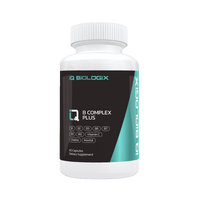



























































































































































































B Complex Plus
Energy and Cofactor
B vitamins run the enzyme reactions behind your energy metabolism, neurotransmitter production, and the methylation cycle that keeps your cardiovascular and cognitive health on track. B Complex Plus covers the full spectrum – including choline and inositol that most B products leave out – at doses well above standard multivitamins, because demand increases significantly with chronic stress, certain medications, and age.
B vitamins are cofactors – your body uses them to run enzyme reactions, but doesn’t manufacture them on its own. They power energy metabolism, neurotransmitter synthesis, the methylation cycle that keeps homocysteine in check, and red blood cell production. When any of them run low, the whole system slows down.
Why above-RDA doses.
The RDA is the floor – the amount needed to prevent clinical deficiency. It’s not the amount needed to run optimally under modern conditions. Stress, alcohol, PPIs (acid-reduction medications), metformin, and oral contraceptives all deplete B vitamins faster than a standard diet replaces them. This formula runs 100mg of B1, B2, and B5 – well above RDA but well below toxicity thresholds – to actually cover elevated demand, not just prevent deficiency.
The methylation layer – B9 and B12.
Folate (700mcg as folic acid) and B12 (cyanocobalamin) work together on the methylation cycle – the process that converts homocysteine into methionine. Elevated homocysteine is an independent risk factor for cardiovascular disease and cognitive decline. These two B vitamins keep that cycle running. Both are in standard forms here; if you have an MTHFR gene variant affecting conversion, separate methylated forms (methylfolate, methylcobalamin) may serve you better.
Choline and inositol – the two most left out.
Most B-complex products stop at B12. Choline is the precursor to acetylcholine – your brain’s primary attention and memory neurotransmitter – and to phosphatidylcholine, a structural component of every cell membrane. Inositol is a cellular messenger involved in insulin signaling, serotonin receptor function, and the stress response. Both are frequently under-consumed from diet alone.
Frequently Bought with B Complex Plus











11 actives. 6 jobs.
Click to expand
01
NAD+ Production
Niacin (B3)
+
−
Niacin (niacinamide form) is a direct precursor to NAD+ and NADP+ – the coenzymes that power over 400 cellular energy reactions. Niacinamide doesn't produce the skin flushing that nicotinic acid causes. NAD+ decline with age is one of the most studied factors in cellular energy and longevity research.
02
Cofactor Activation
Vitamin B6
+
−
Vitamin B6 (pyridoxine HCl) is a required cofactor for over 100 enzyme reactions – including the conversion of 5-HTP to serotonin and L-DOPA to dopamine. The pyridoxine HCl form requires liver conversion to active P5P; the body performs this conversion but efficiency varies individually.
03
Cellular Methylation
Folate (B9)
+
−
Folic acid (700mcg) is essential for DNA synthesis and cell division – the coenzyme for one-carbon metabolism that every dividing cell depends on. Non-methylated form; the liver converts it to active folate. Individuals with MTHFR gene variants may have reduced conversion efficiency and benefit from separate methylfolate.
04
Neurological Support
Vitamin B12
+
−
Vitamin B12 (cyanocobalamin) supports myelin sheath integrity and homocysteine metabolism – elevated homocysteine is an independent cardiovascular and cognitive risk marker. The stable synthetic form; the liver converts it to active methylcobalamin and adenosylcobalamin as needed. Especially important for vegetarians and vegans.
05
Metabolic Cofactor
Biotin (B7)
+
−
Biotin is required by carboxylase enzymes that drive fatty acid synthesis, gluconeogenesis, and amino acid catabolism – three of the body's core metabolic pathways. Best known for hair and nail support; its foundational role in energy metabolism is equally important and less visible.
06
Acetylcholine Precursor
Choline
+
−
Choline is the precursor to acetylcholine – the neurotransmitter behind attention, memory, and muscle activation – and to phosphatidylcholine, a structural component of every cell membrane. Most adults are mildly deficient; dietary sources are concentrated in liver and eggs. Bitartrate salt is stable and bioavailable.